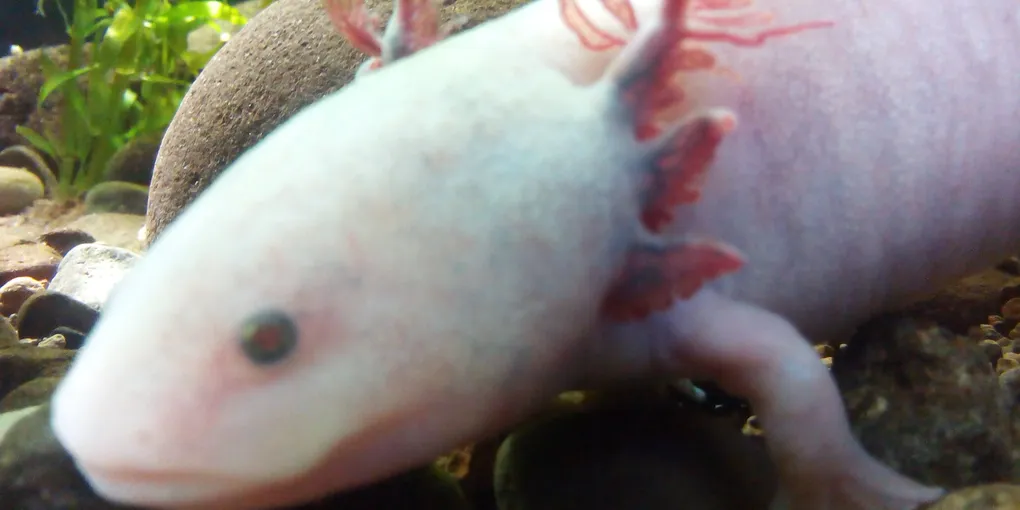
Axolotl Regeneration: What They Can and Can't Regrow
Axolotls can regrow limbs, tails, eyes, parts of the brain and heart. They can't regrow what they've never lost. Here's the full scientific picture of axolotl regeneration.
Axolotl regeneration is the most studied biological superpower in any vertebrate. Adult axolotls can regrow entire limbs, complete tails, sections of the spinal cord, parts of the brain and heart, even portions of damaged eyes. No other adult vertebrate comes close to this ability, which is why axolotls dominate biological research in regenerative medicine.
But the abilities have specific limits. Here’s what they can regrow, what they can’t, and the science behind both.
What Axolotls Can Regenerate
1. Entire limbs (the famous one)
A severed leg regrows completely in 6-12 weeks. The new limb has the same number of fingers, the same bone structure, the same muscle groups, and the same nerve connections as the original. Even more remarkable: if you sever a leg multiple times in different places, each cut regenerates correctly. If you reattach the severed limb backwards, the axolotl will grow another forward-facing limb and the misattached one becomes a vestigial growth.
The process works through a structure called the blastema — a mass of pluripotent cells that forms at the injury site. These cells “remember” their position in the body and recreate the correct tissues.
2. Tails (also regrow completely)
Tail amputation regrows in 4-8 weeks. The new tail includes vertebrae, spinal cord extension, fin tissue, muscle, and blood supply. New tail patterning sometimes differs slightly from the original (color spots may shift) but the structure is functionally identical.
In a tank with multiple axolotls, partial tail bites and full tail amputation are common. The aggressors don’t realize they’re harming a tankmate. See do axolotls bite for why this happens.
3. Gills
External gills are constantly remodeled. When bitten by another axolotl or damaged by water quality issues, gills regrow within 2-4 weeks. The new gill filaments are sometimes paler at first but darken to normal color.
4. Eyes (partial)
Axolotls can regenerate damaged corneas, lens tissue, and even portions of the retina. Complete eye replacement isn’t documented, but significant eye injuries that would blind a mammal can heal in axolotls.
5. Heart tissue
Sections of the heart muscle can regrow without permanent scarring. Mammals form fibrotic scar tissue after heart attacks; axolotls regenerate functional cardiac tissue. This is one of the most actively studied areas of axolotl research because of its implications for human heart attack recovery.
6. Spinal cord segments
Partial spinal cord damage can heal completely in axolotls. Severed spinal connections regrow and re-establish proper function. In mammals (including humans), severed spinal cords result in permanent paralysis. Axolotls don’t have this problem.
7. Brain tissue (forebrain especially)
Damage to the forebrain — the section responsible for movement coordination and basic learning — can regenerate in axolotls. This includes neuronal regrowth, not just glial scar formation. Researchers are studying which signaling pathways axolotls use to repair brain tissue.
8. Liver and lung tissue (partial)
Significant portions of liver and lung can regrow. The axolotl can recover from injuries that would be fatal or permanently disabling in mammals.
9. Jaw bones
Lower jaw amputations can regenerate complete jaw structures with teeth. Some experimental studies have shown that even significant facial trauma can heal without permanent disfigurement.
What Axolotls CAN’T Regenerate
Despite the impressive list above, axolotl regeneration has clear limits.
1. The entire head
A decapitated axolotl is dead. Axolotls cannot regrow heads. Lethal injuries are still lethal.
2. Organs they don’t have
Axolotls can’t regrow what they were never born with. They have lungs and external gills, not a swim bladder. They can’t regrow a swim bladder.
3. Most internal organs (complete)
While axolotls can regenerate portions of the liver, lungs, and heart, complete replacement isn’t documented. Total organ failure is still terminal.
4. Functional eye replacement
Damaged eyes can heal partially, but a completely destroyed eye cannot be fully regrown to functional vision. Severe injuries that destroy the optic nerve are likely permanent.
5. Lost body weight from starvation
Tissue lost to long-term starvation doesn’t return as quickly as injury-induced tissue loss. The regeneration program is triggered by specific injury signals, not by overall body weakness.
6. The aging process
Regeneration doesn’t reverse aging. Old axolotls don’t regenerate as quickly or completely as juveniles. Cellular damage accumulates over decades despite the regeneration ability.
How Regeneration Actually Works
The process is genuinely amazing biology. Here’s the simplified version:
Step 1: Injury and immediate response (hours)
The wound surface seals with a thin layer of epidermal cells called the wound epidermis. Normal mammalian wounds would scar at this point. Axolotls don’t scar.
Step 2: Blastema formation (days)
Cells around the wound de-differentiate — they revert to a pluripotent state, capable of becoming any cell type. This mass of cells forms the blastema, the regeneration engine.
Step 3: Pattern reformation (weeks)
The blastema cells recreate the missing structure based on positional memory — each cell knows where it was in the body. They differentiate into the correct tissues (bone here, muscle there, nerves elsewhere) and re-establish the original anatomy.
Step 4: Growth and maturation (weeks to months)
The new structure grows to full size and integrates with the existing body. Nerves connect. Blood vessels mature. The regenerated tissue becomes functionally identical to the original.
The whole process is coordinated by specific protein signals (BMP, FGF, Wnt pathways, and others) that researchers are still mapping completely.
What Triggers Regeneration
Three signals are required:
- Tissue injury that exposes underlying cells
- Wound epidermis formation without scarring
- Nerve presence at the injury site (denervated stumps don’t regenerate)
The nerve requirement is interesting: amputations done while the nerve is severed don’t trigger regeneration. The nerve provides a signal that activates the blastema.
Why Axolotls and Not Other Animals
Several factors contribute to axolotl regenerative ability:
Neoteny (staying in larval form)
Axolotls remain in their larval form their entire lives — a condition called neoteny. They never metamorphose into terrestrial salamanders. This permanent larval state preserves regenerative abilities that other salamanders lose at metamorphosis.
If you force an axolotl to metamorphose (which is possible by exposing them to thyroid hormone), it loses much of its regenerative ability. The larval state is essential for full regeneration.
Large genome
The axolotl genome is roughly 10x larger than the human genome. Researchers think the extra DNA contains numerous regeneration-related genes that mammals have lost.
Permissive immune system
The axolotl immune system tolerates the cellular rearrangement required for regeneration. Mammals would mount an inflammatory response that would block the process. Axolotls don’t.
Slow metabolism
Cold-water metabolism leaves more energy available for tissue regrowth. Warm-blooded animals spend most of their energy on body temperature maintenance.
Implications for Medical Research
Axolotls are central to regenerative medicine research because their abilities could theoretically be translated to humans. Active research areas include:
- Limb regeneration after amputation — applying axolotl signaling pathways to human stump tissue
- Heart attack recovery — preventing scar tissue formation in damaged hearts
- Spinal cord injury recovery — promoting nerve regrowth after paralysis
- Stroke recovery — using insights from axolotl brain regeneration
The challenge is that human cells have evolved away from the regenerative pathways axolotls retain. Activating them in humans without causing cancer (because pluripotent cells can also become tumors) is the central problem.
For now, axolotl research is foundational science with potentially huge medical impact decades in the future.
What This Means for Pet Owners
If your axolotl loses a limb to a tankmate bite, an accident, or any other cause, it will likely regrow completely. Here’s what to do:
- Identify the cause — if a tankmate, separate immediately. See tankmate compatibility
- Watch for infection — bitten wounds can develop fungus. Methylene blue or salt baths help if needed
- Increase feeding slightly — regeneration uses calories. Add an extra small meal per week during regrowth
- Maintain pristine water — clean water accelerates healing, dirty water slows it
- Don’t disturb the stump — let the wound epidermis form. Avoid handling the axolotl during the first 2 weeks
- Be patient — limb regrowth takes 6-12 weeks. Tail regrowth 4-8 weeks. The early stages look like tiny buds, then progressively develop into recognizable limbs
Most regenerated limbs are anatomically identical to the originals. Occasionally a regenerated tail will have a slight color difference. This is normal.
The Bottom Line
Axolotls can regrow limbs, tails, gills, parts of the brain, heart, and spinal cord. They cannot regrow heads, never-existing organs, or fully destroyed eye structures. The process takes weeks to months and works through a unique cellular structure (the blastema) that other adult vertebrates have lost.
For pet owners, this means many injuries that would be permanent in other animals heal completely in axolotls. For science, it means axolotls are the most important regenerative biology research organism on the planet — and a hint at what human medicine might one day achieve.
For more on axolotl biology, see are axolotls fish and the morph guide for visual variations across the species.
Newsletter
The weekly axolotl note.
One honest care note, one Amazon find, one beginner question answered. Sundays. No spam.
Disclosure: The Axolotl Guide is a participant in the Amazon Services LLC Associates Program, an affiliate advertising program designed to provide a means for sites to earn advertising fees by advertising and linking to Amazon.com. As an Amazon Associate we earn from qualifying purchases, at no extra cost to you.
More Morphs & Colors Guides
Are Axolotls Fish? (No, And Here's Why That Matters)
Axolotls aren't fish. They're amphibians (specifically salamanders). The difference matters enormously for how you keep them. Here's the science.
Pink Axolotl Guide: The Leucistic Morph Explained (Care, Price, Photos)
The classic pink axolotl is a leucistic morph. Pale body, black eyes, bright pink gills. Here's the genetics, the care quirks, and what to pay.
Are Axolotls Nocturnal? (What They Actually Do at Night)
Axolotls are crepuscular, not strictly nocturnal. They're most active at dawn and dusk, active at night, and rest during the day. Here's the full activity pattern.