Are Axolotls Fish? (No, And Here's Why That Matters)
Axolotls aren't fish. They're amphibians (specifically salamanders). The difference matters enormously for how you keep them. Here's the science.
The short answer: no, axolotls are not fish. They’re amphibians, specifically salamanders. And yes, that distinction matters a lot for how you keep them.
What Axolotls Actually Are
Axolotls (Ambystoma mexicanum) are aquatic salamanders native to Lake Xochimilco in Mexico. The scientific category is:
- Kingdom: Animalia
- Class: Amphibia (not Pisces)
- Order: Urodela (salamanders)
- Family: Ambystomatidae (mole salamanders)
- Species: Ambystoma mexicanum
Most salamanders start life with gills in water, then metamorphose to lungs and live on land. Axolotls do something unusual: they keep their gills and stay in the water for their entire 10-15 year lifespan. This is called neoteny. They’re essentially permanent baby salamanders.
Why People Get Confused
Three reasons axolotls keep getting mislabeled as fish:
- They live entirely underwater. Almost every other amphibian leaves the water as an adult.
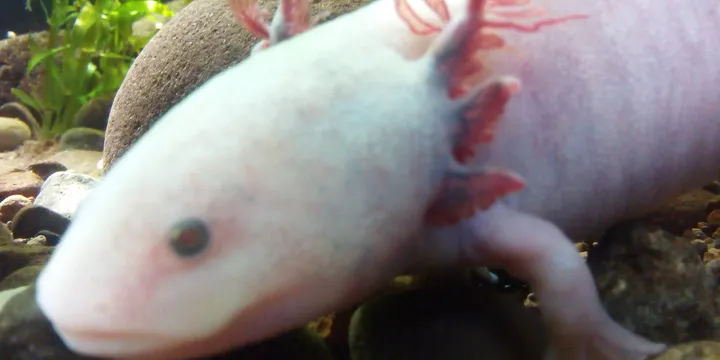
- They have visible gills. Those feathery pink things on the sides of their head look like (and function as) fish gills.
- Pet stores often sell them next to fish. Big-box pet stores stock axolotls in aquarium aisles, leading people to assume they’re fish.
But the differences run deep.
What Makes Axolotls Not Fish
Skeleton. Axolotls have four legs with fingers and toes. Fish have fins.
Skin. Axolotls have moist, permeable amphibian skin that absorbs water and oxygen. Fish have scales.
Breathing. Axolotls have lungs AND gills AND can breathe through their skin. They surface for air occasionally. Fish breathe only through gills.
Reproduction. Female axolotls lay jelly-coated eggs that look like frog eggs. Males deposit spermatophores. Fish lay simple eggs and either spray external sperm or use internal fertilization with claspers.
Cold blood with different metabolism. Axolotls are ectotherms like fish, but their metabolism handles cool water much better than tropical fish.
Why This Matters for Care
The “axolotls are fish” misconception kills axolotls. Specifically:
You can’t keep them with fish. Even friendly community fish will nip at the axolotl’s gills. Larger fish swallow small axolotls. The fish carry parasites that destroy axolotls. There’s no fish/axolotl combo that works long-term.
Their food is different. Most aquarium fish flakes are wrong for axolotls. They need protein-heavy carnivore food (earthworms, sinking pellets formulated for carnivorous amphibians, blackworms). See the full food safety database.
Their water is different. Most tropical fish want 75-82°F. Axolotls want 60-68°F. A “well-meaning” pet store employee who treats axolotls like exotic fish will set you up for failure.
Their tank setup is different. Fish tanks emphasize swimming volume (tall is fine). Axolotl tanks need long footprints because axolotls walk on the bottom.
Their illnesses are different. Ich treatments for fish can be toxic to axolotls. The salt baths fish keepers use need to be carefully dosed for amphibians.
What About “Axolotl Fish” on Amazon?
If you search “axolotl fish” on Amazon you’ll see listings for plush toys, painted models, and the occasional aquarium kit. These products use the term as marketing because that’s how customers search. The product descriptions usually also include “axolotl” or “salamander” correctly. The animals themselves are not fish.
The Closest Animal Comparison
If you want a mental model: axolotls are most similar to tadpoles that never grew up. A tadpole has gills, swims with its tail, and lives underwater. Then it transforms into a frog. An axolotl skips that transformation and stays in tadpole-mode for its entire life, while still developing reproductive organs and reaching adult size.
This is why axolotls are scientifically fascinating. Their cells stay in an “embryonic” state that can regenerate entire limbs, parts of the heart, sections of the spinal cord, and even portions of their brain. Researchers study them specifically to understand regeneration.
Bottom Line
Axolotl: amphibian salamander. Lives in water for life. Not a fish.
If you’re keeping one, treat it like the amphibian it is. Cool water, no tankmates, protein-rich food, real cycling, fine sand or bare bottom, gentle filtration. See our complete tank setup guide for the full walkthrough.
Newsletter
The weekly axolotl note.
One honest care note, one Amazon find, one beginner question answered. Sundays. No spam.
Disclosure: The Axolotl Guide is a participant in the Amazon Services LLC Associates Program, an affiliate advertising program designed to provide a means for sites to earn advertising fees by advertising and linking to Amazon.com. As an Amazon Associate we earn from qualifying purchases, at no extra cost to you.
More Morphs & Colors Guides
Axolotl Regeneration: What They Can and Can't Regrow
Axolotls can regrow limbs, tails, eyes, parts of the brain and heart. They can't regrow what they've never lost. Here's the full scientific picture of axolotl regeneration.
Pink Axolotl Guide: The Leucistic Morph Explained (Care, Price, Photos)
The classic pink axolotl is a leucistic morph. Pale body, black eyes, bright pink gills. Here's the genetics, the care quirks, and what to pay.
Are Axolotls Nocturnal? (What They Actually Do at Night)
Axolotls are crepuscular, not strictly nocturnal. They're most active at dawn and dusk, active at night, and rest during the day. Here's the full activity pattern.