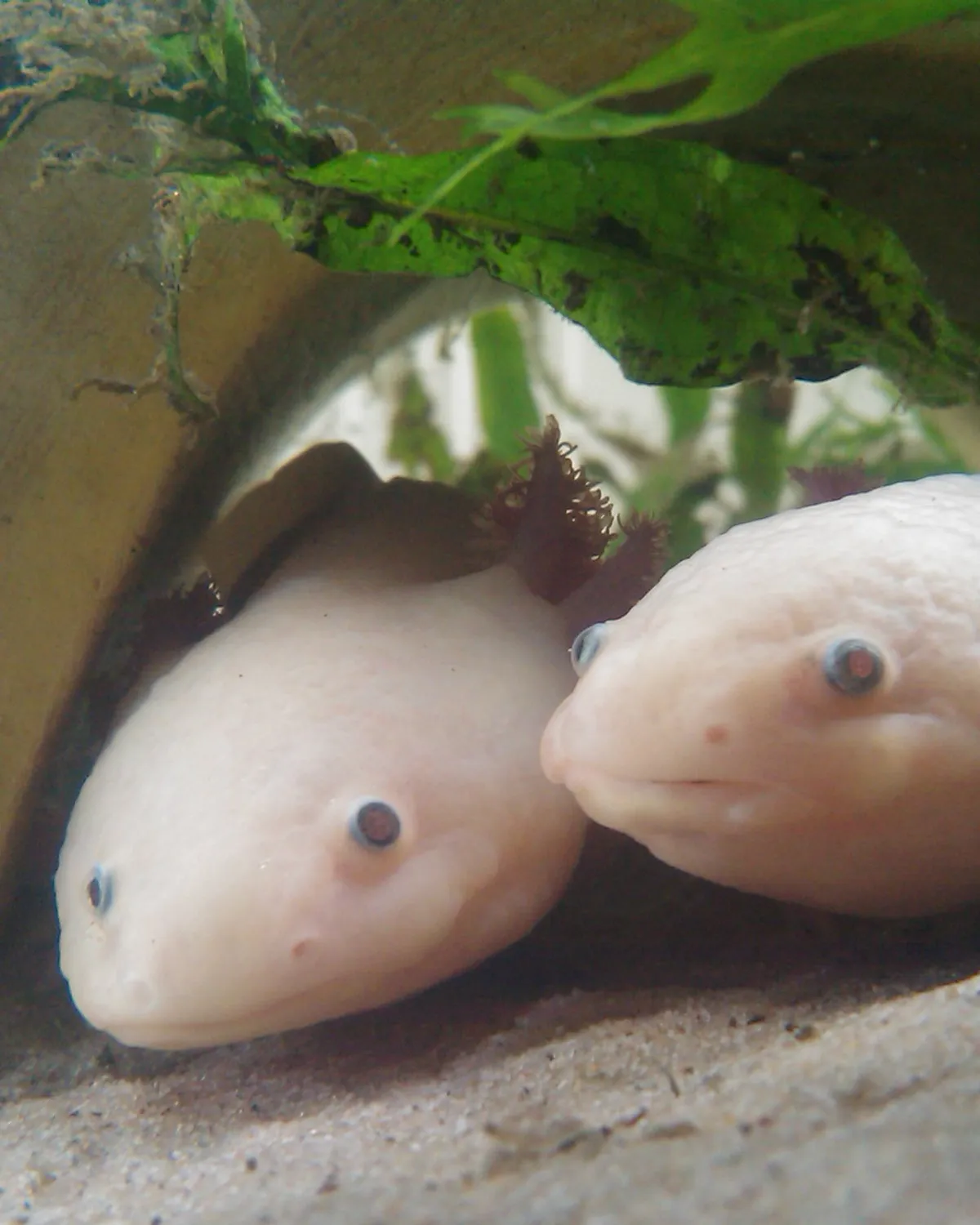
The 9 stages of axolotl breeding
From sexual maturity to raising juveniles — here's exactly what happens at each stage.
1. Sexual maturity
12-18 months oldBoth males and females reach reproductive maturity around 12-18 months, though some individuals delay to 24 months. Females must reach at least 7 inches before breeding safely. Earlier breeding stunts growth.
2. Conditioning
2-4 weeks before breedingDrop water temperature to 55-60°F for 2-4 weeks (simulating winter), then warm back to 65°F. This temperature swing triggers breeding hormones. Feed heavily during conditioning to build egg reserves.
3. Courtship dance
1-3 daysMale performs a 'hula' dance — shaking his tail and circling the female. If receptive, female follows male around the tank, nudging his cloaca.
4. Spermatophore drop
Hours after dance startsMale deposits white cone-shaped spermatophores on tank floor (looks like small white pyramids). Female walks over them and picks them up with her cloaca.
5. Egg laying
24-72 hours after fertilizationFemale lays 300-1,000 eggs over 2-3 days. Eggs are attached to plants, decor, and tank walls in jelly clusters. Each egg is 2-3mm wide with visible black embryo.
6. Egg development
14-21 days at 65°FEmbryos develop visibly through the clear jelly. Temperature affects hatch time — warmer = faster. 65°F is the sweet spot for healthy development.
7. Hatching
Day 14-21Tiny larvae (3-4mm) emerge from eggs. Look like commas with tiny gill buds. Survive on yolk sac for 24-48 hours.
8. First feeding
Days 2-4 post-hatchOnce yolk sac absorbs, larvae need live microscopic food: baby brine shrimp, microworms, daphnia. Pellets don't work yet.
9. Juvenile growth
Months 1-6Daily feeding, frequent water changes (50% twice weekly). Growth from 4mm to 4-5 inches in 6 months. This is the highest-loss period — expect 30-50% mortality even with optimal care.
How to tell male from female axolotls
Sexing axolotls reliably requires the animal to be sexually mature (12+ months) and well-conditioned. Look for:
- Males: Pronounced swelling around the cloaca (vent area). Long, slim body. Cloacal swelling is more obvious during breeding season.
- Females: No cloacal swelling. Wider body, especially the abdomen when carrying eggs. Slightly shorter tail proportional to body.
Juvenile axolotls (under 12 months) can't be reliably sexed by external features.
Conditioning axolotls for breeding
Healthy, well-conditioned adults breed more reliably with healthier eggs. The conditioning protocol:
- Heavy feeding for 4-6 weeks — daily earthworms, blackworms, and pellets. Build up reserves.
- Cool water for 2-4 weeks — drop temperature to 55-60°F (simulating winter)
- Warm water trigger — raise temperature to 65°F over 24 hours
- Introduce female to male's tank — at evening, expect courtship within 24-72 hours
- Monitor closely — separate if either becomes stressed
The breeding tank setup
- Tank size: 40-gallon breeder minimum (more space reduces stress)
- Substrate: Bare bottom or fine sand
- Plants: Multiple silk plants and live plants (eggs attach to leaves)
- Hides: Multiple ceramic caves for stress reduction
- Water: Cool (60-65°F), pristine, well-cycled
- Filter: Sponge filter only — HOB filters suck up eggs and larvae
Identifying axolotl eggs
Axolotl eggs are:
- 2-3mm wide, clear jelly capsule around a dark embryo
- Attached to plants, tank walls, and decor in clusters
- Laid in groups of 10-100 per spot
- Fertile eggs show developing embryo within 48 hours
- Infertile eggs go white and fuzzy (mold), should be removed
Egg care and hatching
Once eggs are laid, separate them from the parents (axolotls eat their own eggs). Options:
- Remove parents — easiest if the breeding tank is dedicated
- Remove eggs — peel off plants/walls with tweezers, transfer to hatching tank
Hatching tank requirements:
- Bare-bottom shallow tank (5-10 gallons)
- Cool water 62-66°F
- Air stone for gentle circulation (no filter — fry get sucked in)
- Daily 50% water changes
- Remove dead/white eggs daily
Raising axolotl larvae
This is the hardest part. Common pitfalls:
- Cannibalism: Axolotl larvae eat each other if hungry or undersized. Separate by size frequently.
- Live food only: Larvae need live, microscopic food. Baby brine shrimp, microworms, daphnia.
- Frequent feeding: 2-3 times per day for the first 2 months
- Water quality: 50% water changes twice weekly minimum
- Temperature stability: Larvae are sensitive to sudden temperature shifts
Realistic survival rate: 30-50% from egg to 1-inch juvenile, even with optimal care. The remaining juveniles need separation into smaller groups by size.
Inbreeding and morph genetics
Don't breed siblings. Inbreeding amplifies genetic defects, reduces immune function, and produces weak offspring. Track parentage carefully.
Morph genetics are recessive in most cases:
- Two leucistic parents = 100% leucistic offspring
- Leucistic × wild type (carrier) = 50% leucistic, 50% wild type
- Two albino parents = 100% albino offspring
- GFP × non-GFP = 50% GFP offspring (incomplete penetrance)
For visual references of every morph, see the complete morph guide.
Ethics and rehoming
Before breeding, ask yourself:
- Can I rehome 100-200 juveniles?
- Do I have buyers lined up?
- Am I prepared for 30-50% mortality (mentally and practically)?
- Can I house unsold juveniles in separate tanks for months?
If any answer is "no" or "maybe," don't breed. Reputable breeders plan everything before triggering the first spermatophore drop.
Selling axolotl babies
If you raise juveniles to sell:
- Wait until at least 3-4 inches and eating pellets before selling
- Vet the buyers — many beginners buy juveniles without knowing care basics
- Use established channels (MorphMarket, Reddit r/axolotlsforsale, Facebook groups)
- Provide care info packet with each axolotl
- Offer post-sale support for the first month
For more on selling/buying axolotls, see axolotls for sale.
Frequently asked about axolotl breeding
How do axolotls breed?
Axolotls breed via internal fertilization. Males deposit white spermatophores (sperm packets) on the tank floor; females walk over them and collect with their cloaca. Females then lay 300-1,000 eggs over 2-3 days, attaching them to plants and tank walls in jelly clusters.
At what age can axolotls breed?
Sexual maturity at 12-18 months. But just because they CAN doesn't mean they should — females should be at least 7-8 inches and 18 months for safe first breeding. Earlier breeding causes egg-binding and shortens lifespan.
How often do axolotls reproduce?
In ideal conditions, healthy adults can breed 2-3 times per year. Breeding every cycle is hard on females (egg production is metabolically expensive). Most ethical breeders rest females between clutches and skip a season annually.
How many eggs do axolotls lay?
300 to 1,000 eggs per clutch. Older, larger, well-conditioned females lay more. First-time breeders lay fewer (sometimes 100-200). Eggs are laid over 2-3 days, attached individually or in jelly strings.
How long does it take for axolotl eggs to hatch?
14-21 days at 65°F. Warmer water speeds development (down to 10-14 days at 70°F) but increases deformity rates. Slower at cool temperatures (3-4 weeks at 55°F).
Can I breed axolotls at home?
Yes, but it's a serious commitment. You'll need multiple tanks (breeding tank, egg tank, multiple juvenile tanks), live food cultures, daily water changes, and a plan for 50-200 juveniles. Most beginner breeders are overwhelmed by the volume.
For care basics, see axolotl care guide. For tank requirements, see tank size guide. For morph genetics, see morph reference.